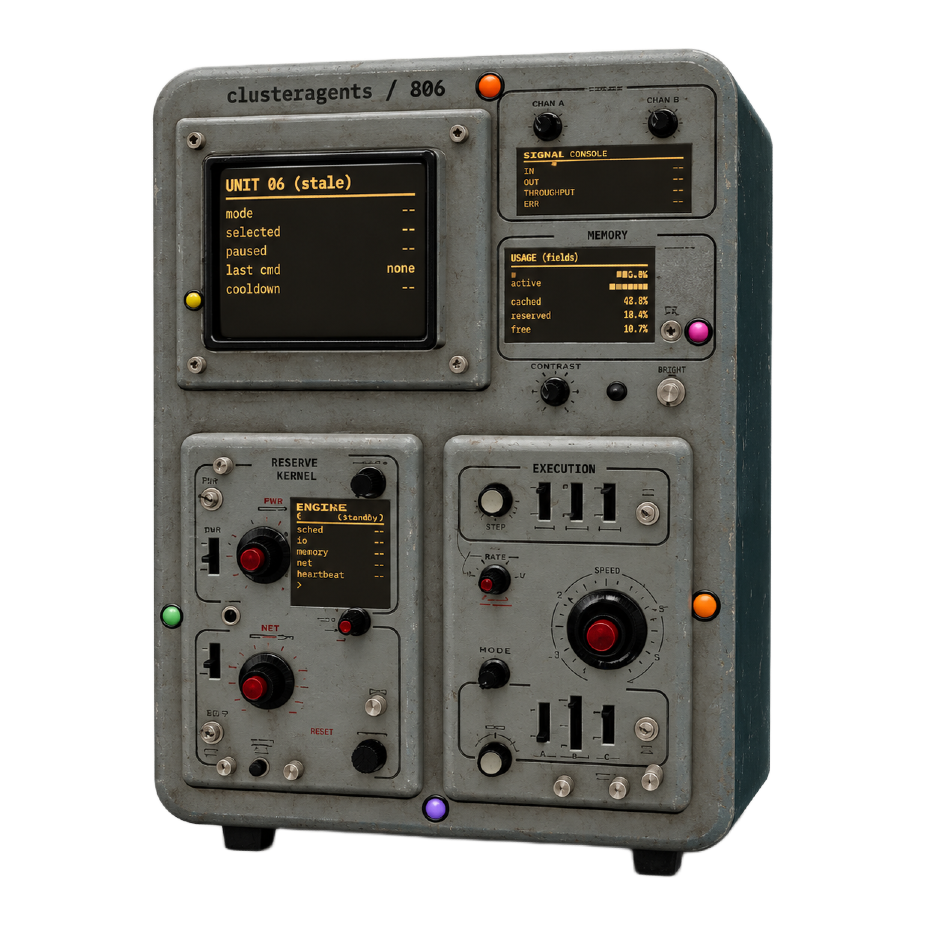
 clusteragents
about.
clusteragents is a small machine that looks after one token. you give it a contract address and the wallet your creator rewards land in. from then on, six agents take turns watching the market and deciding — carefully — when that reward money should go back into the token.
the honest version: most tokens have creator rewards piling up in a wallet, and the "strategy" is someone panic-buying when the chart dips. alder replaces that with a crew that argues it out every cycle, a safety officer with a veto, and a hard rule that part of the money is never touched.
01 · the loopone cycle, start to finish
every few seconds the machine runs a cycle. the engine pulls a fresh market snapshot and the wallet balance, hands it to the agents, collects their reports, and lets alder make the call. every report and every decision is written to the engine's own database — that's what you see scrolling in the activity feed. nothing on the page is simulated.
02 · the crewwho does what
every agent is backed by jev, a model that runs on the engine's server — never in your browser. each one has a narrow job and its own instructions, which the owner can edit.
the eyes. reads the chart and the reward wallet every cycle — price, market cap, 5-minute volume, buys vs sells, how long the chart has gone flat, how much sol is sitting in the wallet. pip never recommends spending. it just says what it sees, and how loud the signal is (0–100).
mossthe steady hand. looks for moments where a small buy actually helps: a healthy pullback, a chart that has stalled while people are still trading. it proposes a buy only when its score clears its threshold (60 by default). tokens it buys stay in the wallet.
emberthe loud one. only speaks up when the market is strong, activity is healthy and the reserve is comfortably funded. then it proposes buy-and-burn: tokens are bought and destroyed, shrinking supply for good. higher bar (72 by default) because it's permanent.
patchthe mechanic. upkeep and diagnostics — small maintenance actions on the project's behalf. off by default; when enabled it needs a 75 to act.
rookthe brakes. checks every proposal against stale data, price impact, thin liquidity, the protected reserve, cooldown, pending transactions and recent failures. rook doesn't need a majority. one veto and nothing moves.
alderthe coordinator. reads all five reports, picks the strongest qualified proposal (or none), sizes it and sends one command to the machine. most cycles the right answer is "hold" — and it says why.
03 · the moneyhow the reserve works
everything in the reward wallet counts as reserve. a slice of it is protected — alder will never spend it, no matter how good the setup looks. what's left is spendable. when a buy is approved, it only uses a fraction of spendable, scaled by how strong the signal is. a mediocre signal spends the low end; a great one spends the high end. never everything.
the defaults are above; each owner can tune them. the cooldown matters more than it looks — it stops the machine from firing five buys into one candle.
04 · the judgementnot "price down = buy"
the dumb version of this idea buys every dip, which just donates money to whoever's selling. alder looks for two specific shapes instead: a stall — the chart has gone flat but people are still trading, so a nudge actually moves things — and a healthy drawdown — a pullback that isn't a collapse, with liquidity still there. a waterfall with no buyers gets a hold, and rook will usually veto it anyway.
05 · the safetywhat stops it going wrong
rook's veto is absolute. the private key for the reward wallet is sent to the engine once, encrypted there, and can never be viewed again — not by the owner, not by the operator. agents never hold keys; only the machine signs. the engine fails closed: if data is stale, a transaction is pending, or anything looks off, the answer is hold.
RUN uses real market and wallet data, real jev reports, alder's decision and command generation. actionable commands are recorded as not sent. no transaction is broadcast. LIVE remains unavailable until the executor is installed and the engine enables it.
06 · yoursrunning your own
connect Phantom to show your wallet without an email account. creating your own cluster is waiting on wallet authorization in the engine; a connected public address alone cannot manage a machine. once supported, setup will ask for your token address and reward wallet. pausing a running machine stops jev calls and their charges.